

To mark its centenary year in aviation, British Airways (BA) is celebrating with a gallery installation that pushes the boundaries of imagination in exploring what the next 100 years may hold for humanity as we continue to traverse the skies.
Just opened, “BA 2119: Flight of the Future” is now on display at London’s Saatchi Gallery in London, running from August 1 through August 26, 2019.
Trending Now
BA collaborated on the project with leading data-trends agency, Foresight Factory, on an in-depth research report to inform its concepts, and commissioned the work of 40 graduate students at the Royal College of Art (RCA) to create the first-of-its-kind exhibition.
Installations depict BA’s visions for the future of flight in both digital and physical form, and as seen through three lenses; aircraft, experience and people.

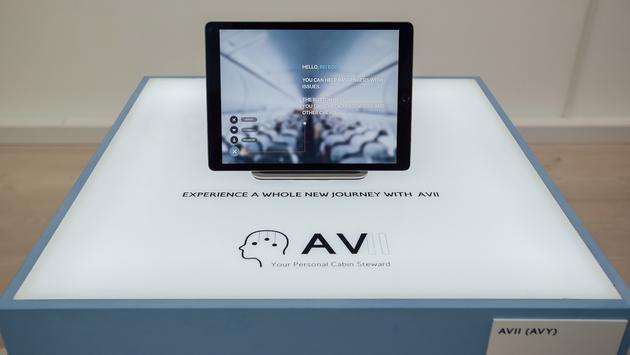
One gallery presentation depicts a robotic air stewardess, whose artificial-intelligence (AI) systems allow her to interpret passengers’ emotional states and anticipate their needs. BA envisions its robotic cabin crew members having built-in technology, which builds a profile for each passenger—including their basic personal information, destination and location of origin, preferred language, known physical and emotional ailments, and their cataloged character traits—in order to provide bespoke service and create a better relationship with each traveler.
Staff would continually scan the cabin, identifying passengers whose mood and comfort-levels indicate that they may need attention, and tailor service accordingly.
Another set of images depicts potential plans for ‘Curio’—a hypersonic jet that continuously circumnavigates the globe, picking up and depositing passengers at ‘megacities’ along its route.
The concept includes many smaller, modular crafts, which would transport customers from their homes within those megacities directly to the larger aircraft by interlocking into designated compartments.
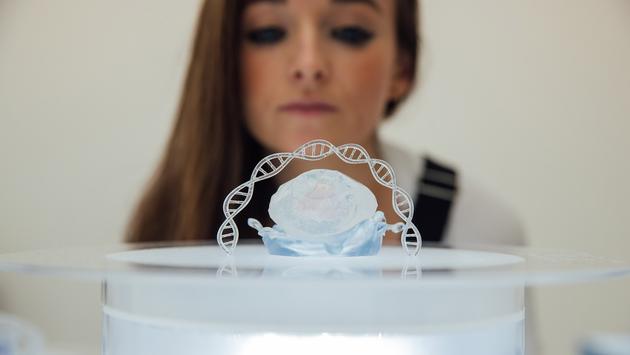
Other potential projects include shape-changing smart luggage called ‘AER’ that adapts its structure and protects its contents using nanotechnology, soft robotics and bio-tech, said to already be in their embryonic stages of development.
AER could autonomously pack your personal items as efficiently as possible, and open only to its owner’s touch using DNA-scanning technology. It also would be able to levitate and transport itself to the airport for baggage check and meet its owner at his or her final destination.
Alongside the exhibit, there’s also an interactive, full-motion, multisensory, virtual reality experience called Fly, which traces humankind’s relationship with flight from its earliest imaginings to Paris’ inaugural passenger flight in 1919.
Built by award-winning VR creators and an Oscar-winning special effects team, Fly positions visitors as time-traveling pilots, who experience flight through the decades, as well as aboard the brand-new A350 Concorde aircraft, and takes them even further into the imagined future of flying.
Entry to the exhibition is free, though tickets for the Fly virtual reality experience may be purchased online in advance.
For more information, visit saatchigallery.com/art/BA_2119.php.


